

It usually covers how organisations operate, including finance, marketing, people, customers and operations. A strong programme also develops decision-making, teamwork, research and business communication at workplace through applied tasks.

How a business management diploma prepares you for a successful career
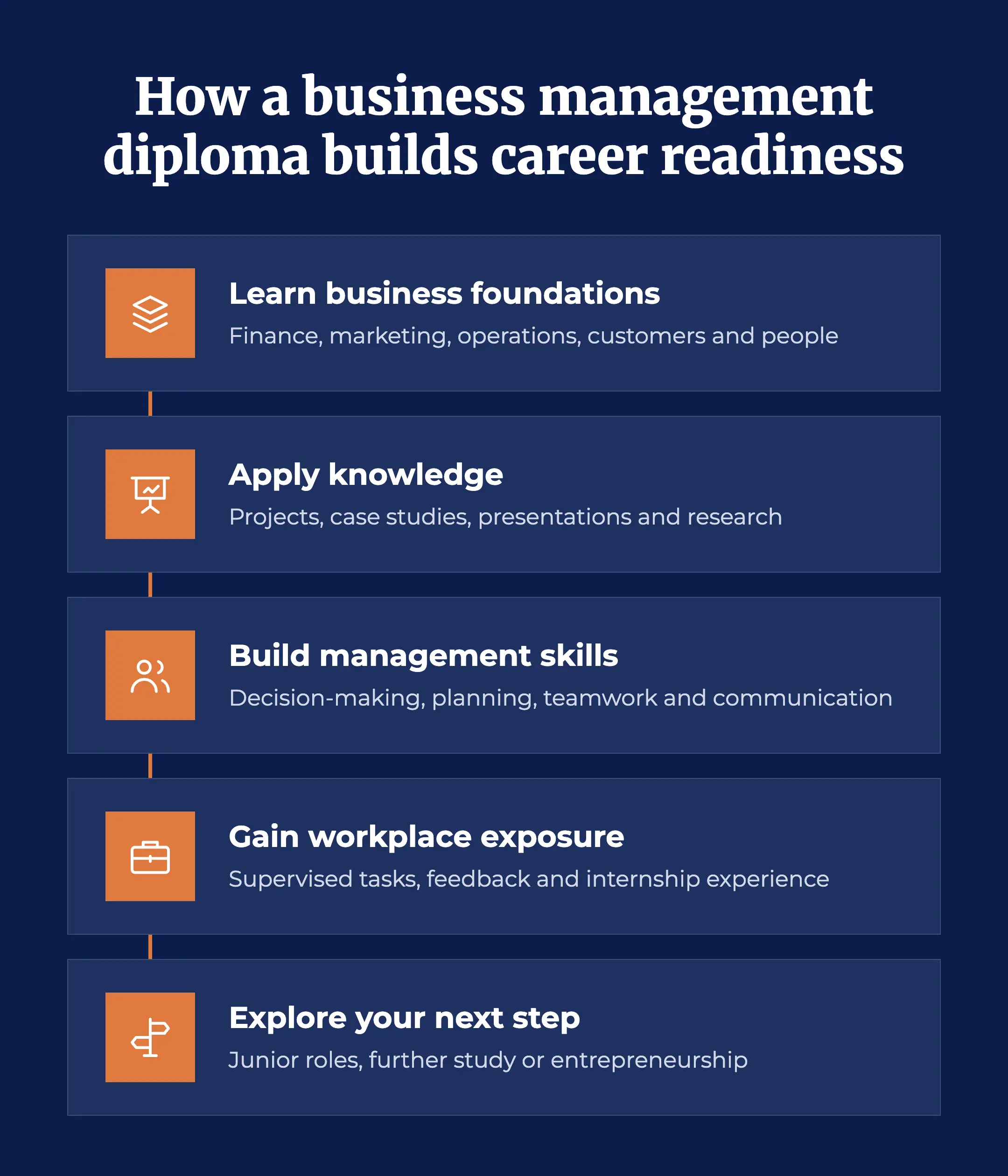
A diploma in business management gives students a foundation in business operations, management and organisational principles. It shows how finance, marketing, people, customers and operations connect, then lets learners practise decision-making when priorities compete. Assignments, projects and presentations can also strengthen the communication and problem-solving skills employers expect.
For students in Riyadh, this foundation also connects with Saudi Vision 2030. The Vision supports economic diversification, private-sector growth and human-capital development, including better alignment between education and labour-market needs. Practical skills in finance, marketing, operations, communication and decision-making can give business students a useful starting point.
Why business knowledge matters across multiple careers
Every organisation must understand its customers, manage money, coordinate people and deliver work reliably. Those needs appear in family businesses, start-ups, government-linked organisations, international companies and growing small and medium enterprises. Learning the basic functions of business therefore gives you knowledge that can travel across sectors.
This breadth does not mean that a qualification makes you ready to manage a company immediately. Early-career roles still require supervision, practice and sector knowledge. The value of a business management course is that it gives you a structured starting point. You can understand why a task matters, how your work affects colleagues and which questions to ask when information is incomplete.
Management skills you can build during a diploma
Understanding how organisations work
Business studies introduce the purpose and structure of organisations. You learn how departments depend on one another and how choices in one area can affect the rest of the business. For example, a marketing campaign may increase demand, but operations must have the people, stock and processes to serve new customers. Seeing these connections helps you move beyond completing isolated tasks.
Using information to make decisions
Managers rarely receive perfect information. They compare options, examine costs, consider risks and explain why one course of action is sensible. Coursework in finance, budgeting, research and planning can help you practice this process. You may review a simple forecast, assess a campaign proposal or recommend how a small business should use limited resources. The goal is not to memorise a single correct answer. It is to make a reasoned decision and support it with evidence.
Communicating with clarity and respect
Good ideas create value only when people can understand and act on them. Presentations, written assignments and group projects give you opportunities to organise information for different audiences. You also learn to listen, ask useful questions and respond to feedback. These habits matter in Riyadh workplaces where teams may include colleagues and customers from different professional and cultural backgrounds.
Working with people and taking responsibility
Team assignments can reveal how you handle deadlines, disagreements and shared responsibility. You may coordinate tasks, support a classmate, keep a project on schedule or adjust a plan when circumstances change. These are early forms of leadership. Effective leadership is not tied to a job title; it begins with reliable work, fair treatment of others and ownership of your decisions.
Benefits of studying business management in Saudi Arabia
One of the main benefits of business management is the opportunity to explore several functions before choosing a direction. A learner who begins with an interest in marketing may discover a talent for finance, events or human resources. Another may prefer operations because they enjoy improving how work is organised. This informed exploration can help you choose later study or entry-level opportunities with more confidence.
A diploma can also develop professional habits. Regular deadlines encourage planning. Research tasks teach you to check the quality of information. Presentations improve preparation and delivery. Case studies help you connect a recommendation to a business objective. Progress comes through repeated practice, so your portfolio of work can become evidence of how you think and communicate.
Feedback is another important part of that development. A tutor may point out that your recommendation needs stronger evidence, that your presentation is unclear or that your team plan assigns responsibilities poorly. Acting on specific feedback helps you recognise patterns in your work and improve them. It also prepares you for the workplace, where responding professionally to guidance is often as important as completing the first version of a task.
Importance of practical education in the classroom and workplace
Applied learning asks you to use business concepts rather than repeat definitions. Imagine that a local retailer wants to introduce online ordering. A classroom project could ask you to identify customer needs, estimate basic costs, plan a promotional approach and consider how staff roles may change. The situation is simplified, but the thinking process resembles workplace problem-solving.
An internship can add another layer by placing learning in a real organisation. You may observe workplace standards, contribute to supervised tasks and learn how teams communicate under time pressure. An internship is not a guarantee of employment, and the experience will depend on the placement and your responsibilities. Its value lies in testing your habits, receiving feedback and understanding the expectations of professional work.
Plan Your Riyadh Study!
Career opportunities after a business management diploma.
Because the subject is broad, graduates may explore junior or support roles in several areas. The right path depends on the employer, sector, role requirements, language skills and further experience. Possible directions include:.
-
Marketing, sales support or customer service roles.
-
Operations, administration or project coordination.
-
Human resources or recruitment support.
-
Finance administration, purchasing or business support.
-
Entrepreneurship or working in a family enterprise, supported by further experience and advice
These are fields to investigate, not promised job outcomes. Read current vacancy descriptions, note recurring skills and compare them with your course content. This simple exercise can show where you are already developing relevant capabilities and where you may need software knowledge, stronger English or Arabic communication, sector-specific training or additional qualifications.
How to choose the right diploma programme
Start with the curriculum. It should cover core business functions and show how learning advances over time. Look for assignments, projects or case studies that require application. Ask how feedback works, who supports students and how any internship component is organised. You should also confirm the delivery schedule, total duration, entry requirements, fees and the exact qualifications awarded.
Recognition deserves careful checking. Ask the institution to explain which organisation approves or awards each part of the programme and request current supporting documentation. If you hope to continue in higher education, contact the receiving institution because progression and credit decisions are made by that institution. Clear answers before enrolment help you compare options responsibly.
The GIE Riyadh practical route
GIE Riyadh currently presents TVTC approved Diploma in Business Management as a two-year, on-campus programme with five semesters. The first four semesters progress from foundation study to more advanced business topics, and the fifth is an internship in business management. The published curriculum includes areas such as business finance, marketing, teams, events, international business, human resources, digital marketing, ethics and career planning.
Students considering this route can check GIE Riyadh’s Diploma in Business Management for the current curriculum, learning hours, entry requirements and application information. Details can change, so use the live page and speak with the admissions team before deciding.
Build a foundation you can keep developing
A TVTC-approved diploma courses in business management can prepare you for many career opportunities by giving you broad business knowledge, guided practice and a clearer view of possible career paths. Its strongest benefit is not a guaranteed title or outcome. It is the ability to enter further study or junior professional work with stronger management skills, better questions and greater confidence in applying what you know.
As you compare programmes in Riyadh, look closely at what you will learn, how you will practice it and how the qualification fits with your next step. A thoughtful choice now can give you a useful platform for continued learning throughout your career.
Frequently Asked Questions
Study with us